

Photoelectric Sensor Market to Reach USD 4.47 Billion by 2035 with 7.6% CAGR
Photoelectric Sensor market
Photoelectric Sensor Market Size, Share and Research Report By Type (Thrubeam, Retroreflective, Diffuse Reflective, Focused Beam Reflective, Small Spot Definite
Rising automation and smart manufacturing are driving strong demand for advanced photoelectric sensors across industrial applications.”
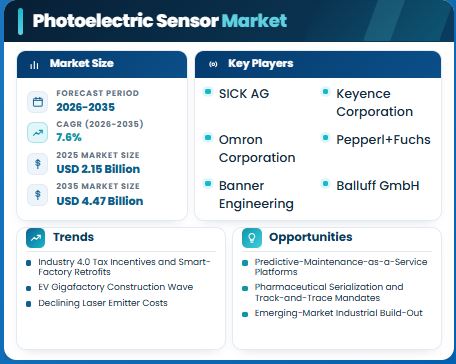
TAIPEI, TAIPEI, TAIWAN, July 14, 2026 /EINPresswire.com/ -- The Global Photoelectric Sensor market was valued at USD 2.15 billion in 2025 and is projected to grow from USD 2.31 billion in 2026 to USD 4.47 billion by 2035, exhibiting a compound annual growth rate (CAGR) of 7.6% during the forecast period. — Market Research Future (MRFR)
Photoelectric sensors non-contact optical devices that detect the presence, absence, distance, or reflectance of objects using emitted and received light beams across thrubeam, retroreflective, and diffuse reflective configurations are foundational components in modern industrial automation, packaging, material handling, automotive manufacturing, food and beverage processing, and logistics infrastructure.
The accelerating global adoption of Industry 4.0 and smart manufacturing frameworks, with worldwide industrial automation spending exceeding USD 265 billion in 2024, is the primary structural driver propelling photoelectric sensor demand, as every automated production cell, conveyor system, and robotic arm requires reliable non-contact object detection to operate at the throughput rates and defect tolerances that modern manufacturing demands.
Two parallel technology shifts are reshaping the photoelectric sensor market’s competitive landscape. The integration of Internet of Things connectivity into industrial sensing platforms is transforming photoelectric sensors from passive detection components into active data-generating assets that stream real-time object-count, cycle-time, and throughput analytics into factory MES and ERP systems.
Simultaneously, ongoing advancements in miniaturization, sensing accuracy, and laser beam source precision are enabling deployment in applications including semiconductor wafer inspection, pharmaceutical blister-pack verification, and microscopic component placement in consumer electronics assembly that were previously impossible with conventional sensor architectures.
The e-commerce sector’s explosive growth, with global online retail expanding at approximately 15% annually, is further fueling demand for photoelectric sensors in high-speed parcel sorting, package detection, and warehouse automation applications where non-contact sensing reliability directly determines throughput economics.
Get Full PDF Sample Copy of Report: (Including Full TOC, List of Tables & Figures, Chart) @
https://www.marketresearchfuture.com/sample_request/8168
➤ How Significant Is the Photoelectric Sensor Market’s Growth?
The photoelectric sensor market’s trajectory from USD 2.15 billion in 2025 to a projected USD 4.47 billion by 2035 represents more than a doubling over the forecast decade, reflecting the structural and sustained expansion of industrial automation, smart factory investment, and the proliferation of non-contact sensing requirements across an ever-widening range of manufacturing, logistics, and consumer-facing applications globally.
Thrubeam sensors command the largest segment share, valued at USD 0.51–1.02 billion, owing to their superiority in long-distance detection across conveyor systems, packaging lines, and access-control gates where high sensing range and immunity to target surface characteristics are paramount. Retroreflective sensors are the fastest-growing type, advancing at a premium CAGR driven by their compact installation footprint and suitability for transparent and reflective object detection in food and beverage and pharmaceutical applications.
Laser beam sources hold the largest beam-source segment at USD 0.34–0.68 billion, prized for their precision in semiconductor inspection and high-accuracy alignment applications, while LED beam sources are the fastest-growing technology, benefiting from lower cost, superior energy efficiency, and ease of integration into IoT-connected smart factory sensor networks.
Manufacturing represents the dominant end-industry at USD 0.51–1.02 billion, while the automotive and transportation sector is the fastest-growing end-user vertical as ADAS assembly lines and EV powertrain manufacturing create sustained new demand for high-reliability non-contact sensing.
➤ What Does the Future Hold for the Photoelectric Sensor Market?
Rising automation across industries is the photoelectric sensor market’s primary and most durable structural demand driver. As manufacturers across automotive, electronics, pharmaceuticals, and food processing continue their Industry 4.0 transformation journeys, the attach rate of photoelectric sensors per production cell is rising steadily.
The International Federation of Robotics projects global robot density rising from 151 units per 10,000 manufacturing employees in 2023 toward 220+ by 2028, and each collaborative and industrial robot installation requires multiple photoelectric sensors for workspace safety monitoring, end-of-arm tooling verification, and pick-and-place position confirmation. Germany’s BMBF EUR 470 million next-generation production research commitment and China’s CNY 58 billion smart-factory demonstration program are sustaining public investment flows that maintain high sensor procurement volumes across the world’s two largest manufacturing economies.
The integration of IoT technologies into photoelectric sensors is transforming their strategic value within factory automation ecosystems. Omron’s strategic partnership with a leading AI technology firm announced to integrate artificial intelligence into its photoelectric sensor product lines exemplifies the industry-wide push toward sensors that go beyond binary detection to provide cycle analytics, predictive cleaning alerts for lens contamination, and adaptive sensitivity adjustment through cloud-connected management platforms.
This IoT convergence is also enabling remote sensor health monitoring, eliminating the need for scheduled manual inspection rounds in large-scale facilities and reducing unplanned downtime from sensor drift or contamination. Real-time data collection and monitoring capabilities are becoming standard features that differentiate premium sensor portfolios from commodity competitors.
The expansion of the e-commerce sector and the resulting surge in logistics automation investment is establishing parcel handling and warehouse sorting infrastructure as one of the photoelectric sensor market’s most significant and fastest-growing commercial application categories. High-speed parcel sorters processing 10,000+ packages per hour rely on arrays of thrubeam and retroreflective sensors for gap detection, package dimensioning trigger points, and divert-gate confirmation signals. As Keyence’s September establishment of a new manufacturing facility in Vietnam signals, leading sensor OEMs are simultaneously expanding production capacity in Southeast Asia to serve the region’s rapidly growing e-commerce and electronics manufacturing demand centers while also reducing supply chain concentration risk.
➤ Who Are the Key Players in the Photoelectric Sensor Market?
The photoelectric sensor market is served by a moderately fragmented competitive landscape dominated by Japanese precision sensing specialists, German industrial sensor manufacturers, and US automation technology leaders with embedded photoelectric sensor portfolios. MRFR identifies the following key participants:
Omron Corporation (Japan) - a global industrial automation and sensing leader focusing on IoT integration and digital transformation, leveraging AI partnerships to enhance photoelectric sensor capabilities, with its E3AS Series TOF Photoelectric Sensors introducing time-of-flight detection and antifouling coating for superior performance in harsh environments
Sick AG (Germany) - a leading industrial sensor and encoder manufacturer emphasizing sustainability and energy efficiency, with an August launch of a new line of photoelectric sensors designed specifically for harsh industrial environments and a collaboration with AutoCoding Systems to bundle sensor technology with software platform integration for production line coding applications
Keyence Corporation (Japan) - renowned for aggressive expansion into emerging markets particularly in Asia, with a September establishment of a new manufacturing facility in Vietnam targeting Southeast Asia’s rapidly growing automation market, and a comprehensive portfolio of laser and LED photoelectric sensors known for industry-leading precision and application engineering support
Panasonic Corporation (Japan) - a major industrial sensor manufacturer providing a broad range of photoelectric sensors across thrubeam, retroreflective, and diffuse configurations, with strong distribution across Asia-Pacific industrial automation markets and integration into its broader factory automation and robotics ecosystem
Rockwell Automation, Inc. (United States) - a global industrial automation leader integrating photoelectric sensors within its Allen-Bradley sensing and safety product portfolio, serving North American discrete manufacturing, automotive, and packaging customers with factory automation sensor solutions embedded within its broader Logix control architecture
Banner Engineering Corp. (United States) - a US specialist in photoelectric sensing technology providing an extensive portfolio of thrubeam, retroreflective, and diffuse sensors for industrial automation, material handling, and packaging applications, with strong channel relationships across North American system integrators and OEM automation builders
Cognex Corporation (United States) - a global leader in machine vision and industrial image-based sensing, providing vision sensors and smart cameras that incorporate photoelectric detection principles for high-accuracy inspection, measurement, and identification applications in electronics, automotive, and pharmaceutical manufacturing environments
Leuze Electronic GmbH + Co. KG (Germany) - a German industrial sensor specialist providing photoelectric sensors, safety sensors, and data communication products for material handling, logistics, and manufacturing automation applications, with particular strength in European e-commerce logistics infrastructure
Pepperl+Fuchs SE (Germany) - a global industrial sensor technology leader providing photoelectric sensors across its comprehensive portfolio for factory automation, process automation, and hazardous-area applications, with particular strength in the Middle East & Africa region where it maintains an established market presence.
Competitive differentiation in the photoelectric sensor market is increasingly achieved through IoT connectivity depth, AI-driven adaptive sensing capabilities, application-specific product variants for hygienic food processing and pharmaceutical environments, and the breadth of installation accessories and teach-in configuration tools that reduce commissioning time for automation integrators.
➤ What Are the Emerging Trends in the Photoelectric Sensor Market?
Several transformational trends are redefining the photoelectric sensor market’s evolution through 2035:
IoT Integration & Real-Time Factory Analytics: The incorporation of IoT connectivity into photoelectric sensors is enabling real-time object-count, throughput, and contamination-event data streaming into MES and ERP platforms, transforming sensors from passive detection components into active factory intelligence assets. Omron’s AI technology partnership exemplifies the industry-wide push toward sensors that provide predictive cleaning alerts, adaptive sensitivity, and remote health monitoring as standard platform features.
Smart Manufacturing & Industry 4.0 Demand Expansion: Government-backed smart-factory investment programs including Germany’s EUR 470 million BMBF production research commitment and China’s CNY 58 billion demonstration-zone program are sustaining high sensor procurement volumes as manufacturers install sensor-dense automated lines requiring precise non-contact object detection at every conveyor transfer, robotic pick station, and quality gate.
LED Beam Source Emergence as Cost-Efficient Alternative: LED beam source photoelectric sensors are gaining rapid market traction as the fastest-growing beam-source technology, combining low energy consumption, long service life, and decreasing unit costs with adequate performance for the majority of material-handling and packaging detection applications, making them the preferred choice for cost-conscious mid-market automation deployments across emerging economies.
Retroreflective Sensor Adoption for Transparent Object Detection: Retroreflective photoelectric sensors with polarization filters are emerging as the fastest-growing sensor type, driven by food and beverage and pharmaceutical producers’ growing need to detect glass bottles, clear plastic packaging, and transparent blister packs on high-speed production lines where diffuse and thrubeam configurations struggle with low-reflectance target surfaces.
E-Commerce Logistics Automation as a High-Growth Application: Global e-commerce expanding at approximately 15% annually is creating sustained demand for dense photoelectric sensor arrays in high-speed parcel sorting conveyors, automated storage and retrieval system pick aisles, and cross-belt sorter divert-gate confirmation applications where sensor reliability at speeds exceeding 2.5 meters per second is a critical system performance requirement.
Renewable Energy Sector Monitoring Applications: The rapid expansion of solar panel and wind turbine manufacturing is creating new photoelectric sensor application categories in photovoltaic cell defect inspection, solar panel alignment verification during automated installation, and blade-surface quality monitoring during wind turbine component manufacturing, establishing renewable energy as an emerging high-growth end-use vertical for the photoelectric sensor market through 2035.
Get access to the full description of the report @
https://www.marketresearchfuture.com/reports/photoelectric-sensor-market-8168
➤ How Is the Photoelectric Sensor Market Segmented?
The photoelectric sensor market report provides a comprehensive segmentation framework:
By Type: Thrubeam, Retroreflective, Diffuse Reflective, Focused Beam Reflective, Small Spot Definite Reflective, Fixed Distance
By Beam Source: Laser Beam Source, Infrared (IR) Beam Source, LED Beam Source
By Industry: Consumer Electronics, Manufacturing, Automotive & Transportation, Food & Beverage, Healthcare/Life Science & Pharmaceuticals, Power & Utilities, Others
By Region: North America, Europe, Asia-Pacific, South America, Middle East and Africa
➤ What Are the Regional Insights from the Photoelectric Sensor Market?
North America is the largest market for photoelectric sensors, holding approximately 40% of the global share, driven by the region’s deep adoption of industrial automation, stringent workplace safety regulations mandating non-contact presence detection in machinery guarding applications, and the rapid expansion of e-commerce fulfillment and logistics automation infrastructure.
Europe is the second-largest market, accounting for approximately 30% of the global photoelectric sensor market share, with growth propelled by stringent environmental regulations, a strong focus on sustainability and energy efficiency, and robust industrial automation adoption across Germany’s precision manufacturing base and France’s automotive and aerospace sectors.
Asia-Pacific is the fastest-growing region for photoelectric sensors, holding approximately 25% of global share in 2025, with China and India leading expansion driven by rapid industrialization, government-backed smart manufacturing programs, and increasing automation investment across electronics assembly, automotive component manufacturing, and food processing.
The Middle East & Africa, along with South America, represent emerging growth markets for the photoelectric sensor market, accounting for approximately 5% of global share. The Middle East is gradually adopting industrial automation in oil & gas, petrochemical, and food processing sectors, with Pepperl+Fuchs maintaining strong regional presence for hazardous-area sensor applications.
➤➤➤ Regional & Country-Level Reports by Market Research Future:
US Photoelectric Sensor Market -
https://www.marketresearchfuture.com/reports/us-photoelectric-sensor-market-19696
➤➤➤ Industry Analysis Reports by Market Research Future:
Leak Detection And Repair Market-
https://www.marketresearchfuture.com/reports/leak-detection-and-repair-market-33382
Tape Storage Market-
https://www.marketresearchfuture.com/reports/tape-storage-market-33976
Real Time Operating System Market-
https://www.marketresearchfuture.com/reports/real-time-operating-system-market-34731
Hospital Logistics Robot Market-
https://www.marketresearchfuture.com/reports/hospital-logistics-robot-market-35060
Electronic Toy Market-
https://www.marketresearchfuture.com/reports/electronic-toy-market-36101
Quadruped Robot Market-
https://www.marketresearchfuture.com/reports/quadruped-robot-market-36232
Dismounted Soldier System Market-
https://www.marketresearchfuture.com/reports/dismounted-soldier-system-market-36506
Rf Plasma Generator Market-
https://www.marketresearchfuture.com/reports/rf-plasma-generator-market-36646
Data Roaming Market-
https://www.marketresearchfuture.com/reports/data-roaming-market-36828
Studio Lighting Market-
https://www.marketresearchfuture.com/reports/studio-lighting-market-37848
Sagar Kadam
Market Research Future
+ +1 628-258-0071
email us here
Legal Disclaimer:
EIN Presswire provides this news content "as is" without warranty of any kind. We do not accept any responsibility or liability for the accuracy, content, images, videos, licenses, completeness, legality, or reliability of the information contained in this article. If you have any complaints or copyright issues related to this article, kindly contact the author above.
