

Data Classification Market to Surge at 22.7% CAGR, Anticipated to Reach USD 15.38 Billion by 2035
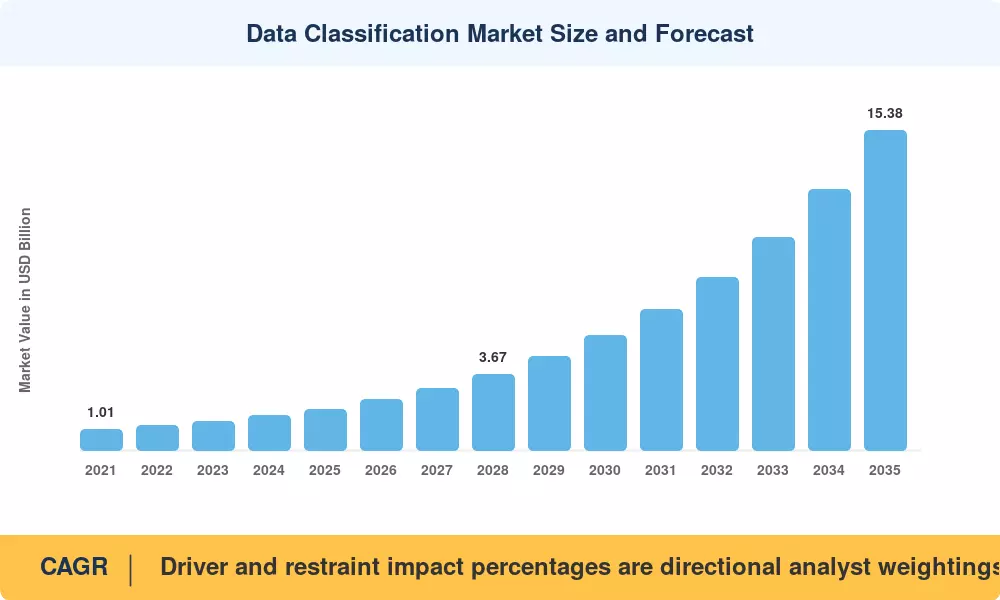
Data Classification Market
Data Classification Market grows as businesses adopt AI, automation, and advanced security tools to protect sensitive data and meet compliance needs.
Data Classification Market is advancing data security by enabling organizations to identify, organize, and protect sensitive information effectively.”
BERLIN, BERLIN, GERMANY, August 28, 2026 /EINPresswire.com/ -- The Data Classification Market is experiencing strong expansion as enterprises prioritize data security, privacy, compliance, and information governance. The market reached USD 1.99 billion in 2025, is expected to reach USD 2.44 billion in 2026, and is projected to grow to USD 15.38 billion by 2035, representing a 22.7% CAGR.— Market Research Future
Regional growth is closely connected with cybersecurity regulations and digital infrastructure development. North America accounted for 37.8% of 2025 market revenue, supported by zero-trust initiatives, while Asia-Pacific is expected to grow at a 23.6% CAGR through 2035, driven by sovereign-cloud programs across India, Japan, and Saudi Arabia.
[PDF Brochure] Request for Sample Report -
https://www.marketresearchfuture.com/sample_request/7378
What Is the Data Classification Market?
The Data Classification Market covers technologies and services that identify, categorize, label, and organize information according to its sensitivity, business value, and regulatory requirements. These solutions help enterprises determine which information requires additional protection and how it should be managed.
Data classification is an important component of the broader data security market, supporting organizations in identifying confidential, personal, financial, healthcare, and business-critical information. Classification can use content, metadata, context, rules, user behavior, artificial intelligence, and machine learning.
Growing Enterprise Data Volumes
The continuous growth of digital information is one of the primary factors supporting the Data Classification Market. Enterprises generate enormous amounts of emails, documents, customer records, databases, application information, and collaboration files across increasingly distributed environments.
Without appropriate classification, security teams may struggle to determine which information is sensitive and which assets require stronger controls. Automated classification helps organizations create visibility across large data repositories while supporting more efficient security, governance, retention, and access-management processes.
Cybersecurity Risks Driving Adoption
Increasing cyber threats are encouraging enterprises to strengthen their data protection strategies. Sensitive information can become an attractive target for ransomware, unauthorized access, insider threats, and data breaches, making accurate identification of high-value information increasingly important.
Data classification enables organizations to prioritize protection according to information sensitivity. Classified data can be connected with encryption, access controls, monitoring, data loss prevention, and other security technologies, helping organizations build a more comprehensive enterprise data security framework.
Regulatory Compliance and Data Privacy
Privacy regulations and industry-specific compliance requirements are important growth factors for the market. Organizations need to understand what information they collect, where it is stored, who can access it, and how long it should be retained.
Data classification for compliance provides a structured way to identify sensitive and regulated information. Automated classification can reduce manual work while helping enterprises establish consistent governance policies across departments, cloud platforms, databases, and file repositories.
Buy Now Get Comprehensive Market Insights -
https://www.marketresearchfuture.com/checkout?currency=one_user-USD&report_id=7378
Artificial Intelligence and Machine Learning
Artificial intelligence is transforming the way organizations classify information. Traditional approaches often depend on manually created rules and employee labeling, while modern solutions can analyze content, context, metadata, and patterns to classify information automatically.
Machine learning can improve classification accuracy by recognizing patterns associated with sensitive information. Natural language processing can also help analyze documents and communications, creating opportunities for more intelligent AI-powered data classification and continuous monitoring across complex enterprise environments.
Cloud Data Classification
Cloud adoption is creating significant opportunities for data classification providers. Organizations increasingly store information across public cloud platforms, private clouds, SaaS applications, and hybrid infrastructures, making data visibility more difficult to maintain.
Cloud-based classification solutions can help enterprises discover sensitive information across distributed environments and apply consistent security policies. Hybrid solutions are also important for organizations that need to manage legacy systems while gradually transitioning workloads and information to cloud infrastructure.
Market Segmentation
The Data Classification Market can be segmented according to classification type, deployment model, organization size, industry, and geography. Classification methods include content-based, context-based, rule-based, user-driven, and machine-learning-based approaches.
Deployment models generally include on-premises, cloud, and hybrid environments. Major end-use sectors include banking and financial services, healthcare, government, IT and telecommunications, retail, manufacturing, education, and professional services, where sensitive information requires structured protection.
Banking and Financial Services
Financial institutions handle large volumes of customer, payment, transaction, and confidential business information. As digital banking and financial technology services expand, institutions require stronger visibility into sensitive data and more effective information protection.
Data classification helps financial organizations identify high-value records and apply appropriate controls. Integration with data loss prevention, identity management, encryption, and compliance platforms can further strengthen financial data security while supporting governance requirements.
Healthcare and Life Sciences
Healthcare organizations manage highly sensitive patient, clinical, insurance, and research information. The growing adoption of electronic health records, cloud applications, and digital healthcare platforms is increasing the need for structured data discovery and classification.
Healthcare providers can use classification technologies to identify sensitive information and support appropriate access and protection policies. Automated approaches can be particularly valuable when organizations manage large volumes of structured and unstructured medical information.
North America Market Outlook
North America remains a major regional market for data classification, supported by mature cybersecurity ecosystems, cloud adoption, enterprise technology investment, and regulatory requirements. The region represented 37.8% of market revenue in 2025, according to the provided market outlook.
Zero-trust security initiatives are strengthening the need for better visibility into information and access environments. Organizations are increasingly connecting classification with identity, access, governance, and security controls to improve protection of sensitive enterprise information.
Asia-Pacific Market Outlook
Asia-Pacific is positioned as a high-growth region for the Data Classification Market. The region is expected to achieve a 23.6% CAGR through 2035, supported by digital transformation, cloud adoption, expanding data volumes, and increasing emphasis on data sovereignty.
India, Japan, and Saudi Arabia are seeing growing attention toward sovereign-cloud and localized digital infrastructure initiatives. These developments are encouraging enterprises and public-sector organizations to adopt technologies that provide greater control, visibility, and protection for sensitive information.
European Market Outlook
Europe represents another important market because organizations increasingly focus on privacy, information governance, and responsible data management. Enterprises operating in regulated industries require clear visibility into sensitive information and stronger controls over how data is processed.
The growing emphasis on privacy-aware digital transformation is encouraging organizations to adopt automated discovery and classification technologies. Integration with governance, risk, compliance, and security platforms can further increase the value of classification solutions.
Key Market Trends
One major trend is the shift from manual labeling toward automated classification. Enterprises increasingly require systems that can continuously discover and categorize information rather than relying entirely on employees to identify sensitive files.
Another important trend is the integration of classification with cloud security and data governance. Organizations want unified visibility across hybrid and multi-cloud environments, allowing them to apply consistent policies regardless of where information is stored or processed.
Emerging Market Opportunities
The growth of unstructured data represents a significant opportunity for classification technology providers. Emails, contracts, presentations, collaboration files, reports, and other documents can contain confidential information that may be difficult to identify using traditional security methods.
Another opportunity is the integration of classification with artificial intelligence, data loss prevention, identity management, and compliance platforms. Solutions that combine discovery, classification, risk assessment, and automated policy enforcement can address multiple enterprise requirements within a unified security ecosystem.
Market Challenges
Despite strong growth prospects, implementation challenges remain. Large enterprises often operate complex environments containing legacy applications, duplicated records, inconsistent formats, and geographically distributed repositories, making accurate classification difficult
.
Classification accuracy is another important consideration. Excessive classification can create unnecessary restrictions and operational complexity, while insufficient classification can leave sensitive information exposed. Providers therefore need to balance automation, accuracy, contextual understanding, and human oversight.
Browse Full Report Details -
https://www.marketresearchfuture.com/reports/data-classification-market-7378
Competitive Landscape
The competitive landscape includes companies operating across cybersecurity, cloud computing, enterprise software, information governance, and data management. Market Research Future profiles organizations such as Microsoft, Amazon Web Services, IBM, Google, Salesforce, Oracle, SAP, Cisco, and Adobe within its Data Classification Market research.
Competition is increasingly focused on artificial intelligence, automation, cloud integration, scalability, accuracy, and interoperability. Providers that can deliver simple deployment while supporting large and complex enterprise environments may gain stronger opportunities as demand for classification solutions expands.
Future Outlook
The future of the Data Classification Market will be shaped by artificial intelligence, cloud computing, cybersecurity, privacy, and data governance. Organizations are moving toward continuous data discovery, where information can be identified, categorized, monitored, and reassessed as its context or risk changes.
As businesses continue generating information across cloud and hybrid infrastructures, classification will become increasingly important for determining how data should be protected and managed. Strong demand for automation, compliance, and secure digital transformation is expected to support sustained market expansion.
Key Takeaways
• The Data Classification Market is growing alongside enterprise data and cybersecurity requirements.
• AI and machine learning are making classification more automated and intelligent.
• Privacy regulations and compliance requirements are supporting adoption.
• North America represented a significant portion of the market in 2025.
• Asia-Pacific is expected to register strong growth through 2035.
• Cloud and hybrid environments are creating new classification requirements.
• Integration with cybersecurity and governance platforms will remain a major market trend.
Frequently Asked Questions
What is the Data Classification Market?
It covers technologies that identify, categorize, and manage data according to sensitivity, business value, and regulatory requirements.
What is driving the Data Classification Market?
Enterprise data growth, cybersecurity risks, cloud adoption, privacy regulations, and demand for automated governance are key drivers.
How does AI support data classification?
AI analyzes content, context, metadata, and patterns to automatically identify and classify sensitive information.
Which industries use data classification?
BFSI, healthcare, government, IT, telecommunications, retail, manufacturing, and professional services are major users.
Why is cloud data classification important?
It helps organizations discover and protect sensitive information distributed across public, private, and hybrid cloud environments.
Which region is growing fastest?
Asia-Pacific is expected to be among the fastest-growing regions, with a projected 23.6% CAGR through 2035 based on the provided market outlook.
What is the future of data classification?
The market is moving toward AI-driven, automated, continuous classification integrated with data security, governance, and compliance platforms.
➤➤View Regional and Global Country Reports Covering Key Developments in the Main Keyword Market.
Brazil Data Classification Market-
https://www.marketresearchfuture.com/reports/brazil-data-classification-market-60026
Canada Data Classification Market-
https://www.marketresearchfuture.com/reports/canada-data-classification-market-60018
China Data Classification Market-
https://www.marketresearchfuture.com/reports/china-data-classification-market-60024
Europe Data Classification Market-
https://www.marketresearchfuture.com/reports/europe-data-classification-market-60021
France Data Classification Market-
https://www.marketresearchfuture.com/reports/france-data-classification-market-60017
Gcc Data Classification Market-
https://www.marketresearchfuture.com/reports/gcc-data-classification-market-6001
Germany Data Classification Market-
https://www.marketresearchfuture.com/reports/germany-data-classification-market-6001
India Data Classification Market-
https://www.marketresearchfuture.com/reports/india-data-classification-market-60022
Italy Data Classification Market-
https://www.marketresearchfuture.com/reports/italy-data-classification-market-60020
Japan Data Classification Market-
https://www.marketresearchfuture.com/reports/japan-data-classification-market-60016
Mexico Data Classification Market-
https://www.marketresearchfuture.com/reports/mexico-data-classification-market-60023
South Korea Data Classification Market-
https://www.marketresearchfuture.com/reports/south-korea-data-classification-market-60014
Spain Data Classification Market-
https://www.marketresearchfuture.com/reports/spain-data-classification-market-60025
Uk Data Classification Market-
https://www.marketresearchfuture.com/reports/uk-data-classification-market-60013
Market Research Future
Market Research Future
+ +1 855-661-4441
email us here
Legal Disclaimer:
EIN Presswire provides this news content "as is" without warranty of any kind. We do not accept any responsibility or liability for the accuracy, content, images, videos, licenses, completeness, legality, or reliability of the information contained in this article. If you have any complaints or copyright issues related to this article, kindly contact the author above.
